
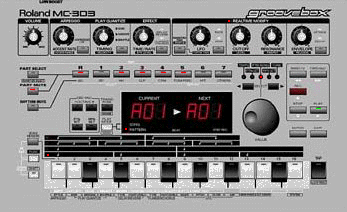
 Today I Started Celebrating Again (alt) / Will Oldham
Dude's cover of RK's "Ignition" is atrocious. And dude blew in the DJ tent at Intonation last summer, where he demonstrated nothing except the high irony quotient of his iPod library. But none of that means Oldham can't get down.
"Today I Started Celebrating Again" is the single moment of brilliance on an otherwise mediocre 1999 compilation that highlights the tricky magic of The Groovebox. A reference to Merle Haggard, gentle grooving pops, and "I am drinking again" are more than enough to start this party. Barring Jim Guthrie's "Who Needs What," I can't think of a song so quiet that makes me want to dance so bad. Think overweight and white; think a Bud in each hand; think John Travolta just barely moving on the dancefloor at Jack Rabbit Slim's. Think DANCING in the mirror.
I'm on vacation for a week. This is the celebration.
April 28, 2006
At Home with the Groovebox

April 23, 2006
Dating Advice from the Smarter Sex
The Worrying Way / The Fabulettes [dead link]
Tip #103: Date a philanderer, and all the worrying you do will subtract pounds, especially from your hips. (Thanks to Naomi.)
Dicks Don't Grow On Trees / Robyn Archer [new link]
Tip #009: If you're attracted to penis, you should date a male animal. (Thanks to AQ.)
This second tune comes from the incredible 365 Days Project at Ubuweb and is jam-packed with astounding facts...
Fact: I know that you could root, root, root with a well-made Japanese substitute / But I realize you'd rather have the real thing / Woo! Give me that ping!
Fact: There ain't no cock trees, prick trees, or dick trees.
Fact: You'd be lucky if you get one dried-up old scrotum.
April 21, 2006
No Junk No Soul?
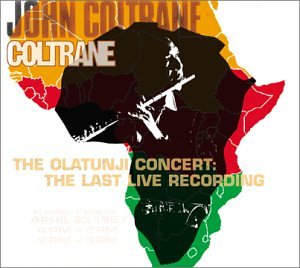 MP3 My Favorite Things (live) / John Coltrane [31.7 MB]
Yesterday I went to a traditional shaman ceremony in northern Seoul. We saw the 75-year-old North Korean woman who started the shaman resurgence in Korea in the 1970s. We saw a possessed shaman in drag dance on a giant knife blade. We saw a woman who'd hired shamans for a private ritual get pelted with rice and beans. And we saw voodoo-like dolls being made to scare evil spirits away from the real bodies of children.
Those were the highlights. But the one thing you don't really notice until it's gone, the one thing that truly matters, is the music. Whenever the music stops, the sacred quality of the rituals dissipates almost entirely. Without the incessant rhythms and the simple melodies, the magic just isn't there. My favorite instrument was the "taepyongso," which sounds like a stunted oboe crossed with a recorder. That is, like the alto sax in free jazz. It's riffs sound like Ornette Coleman or Albert Ayler even when they're entirely harmonious.
This version of "My Favorite Things" is from Coltrane's last live recording, from one of the two shows he played in Olatunji, Africa, in 1967. There's no alto here, but the song still reminds me of the taepyongso, if only because it's as primal as can be. In "Brian the Bachelor," a season four episode of Family Guy, Brian and Brooke bond over "early Coltrane, before he got clean." Brian comments, yeah, yeah, "no junk no soul." But that is bullshit. Listen to this song and tell me Coltrane has no soul at the end of his career in '67. Sanders and Coltrane both sound as if they're punishing their own enormous spirits—trapped deep inside their instruments—until they scream cries and are freed. Only for the briefest moments does any of this maniacal 34-minute trip resemble "My Favorite Things," and the only one who needs junk to take it is the listener. This is not for the faint of heart. This is for someone with a desert or two and not much else.
John Coltrane, soprano, tenor saxophone; Pharoah Sanders, tenor saxophone; Alice Coltrane, piano; Jimmy Garrison, bass; Rashied Ali, drums; Algie Dewitt, bata drum; probably Jumma Santos, percussion
Also: Check out Armrest, a music blog that thoughtfully analyzes the way specific contemporary songs borrow from their ancestors.
April 20, 2006
The Stereotypical Furniture Mover
Thin Blue Flame / Josh Ritter [2006]
I am seated at the DWM table with George Washington, Babe Ruth, Dean Moriarty, and Chris Farley. Only one of us is unreal; the rest are dead. There are pitchers of cold beer, shots of whiskey, and tobacco. Washington remarks that he got plastered only two days earlier.
Our hands are dealt by someone famous whom I don't recognize. He might be Greek or a writer. Either way, I see nothing good all night except once, full of spades. We drink and lose our money to the Babe. He reaches over to sweep in the pot, and his gut creases against the tabletop. Farley does a great impression.
I've never heard so much bullshit spoke in one night. Dean stands up occasionally, as if to leave, only to remember through the haze of alcohol that his car is in the shop. He smacks the dealer on the back each time, returns to his seat, and asks for a set of ladies. More material for Farley, for everyone.
By the time we finish our third bottle of Jack the laughing begins to slow. Soon we stop talking entirely. The music picks up, and the rest of the people in the bar are, for the first time, really there. The radio hangs above the mirror and the bottles. It should be "Desolation Row" but it isn't. We look over and notice a machine making special air next to the speakers. Air that makes it so you don't need tragedy for meaning.
This is heaven. They have that here.
April 18, 2006
They removed the front of my eyeballs and stitched them to my upper back
Debaser (Pixies cover) / Feed
Covering a song like "Debaser" is a waste. Bands should cover "Emulsified" and "Why I Hated August 93." Bands should cover "Let's Talk About Spaceships" and "Federal Dust." Bands should borrow greatness only when they're playing live. Bands should leave those versions unreleased.
Bands should mutilate greatness so far it's turned inside-out, returning to somewhere neither of them have ever been before. Bands should undergo surgery for the good of the nation. (Bands should glue their brains to the ceilings of their skulls.) Bands should try to marry other bands by screaming "I love you I love you I love you," in other words.
Bands should do this, precisely. This is a terrible beauty. The first two minutes are a declaration of love. At 2:01, it sounds like "Karate Feelings" will start playing. Then two minutes more: Frank Black on bottom?
April 15, 2006
Don't Talk to Me About Gene Hackman
Top 10 Songs Titles Since 1998
10. They Are Night Zombies!! They Are Neighbors!! They Have Come Back from the Dead!! Ahhhhh! (Sufjan Stevens, 2005)
9. Get the Fuck Off My Cloud (Blood on the Wall, 2005)
8. Vikings Invade the Mediterranean But Don't Leave (Prefuse 73, 2002)
7. I'm Getting Back Into Getting Back Into You (Silver Jews, 2005)
6. If You Shoot the Head You Kill the Ghoul (Jeffrey Lewis, 2003)
5. Judy Is a Dick Slap (Belle & Sebastian, 2000)
4. Me and Jesus the Pimp in a '79 Granada Last Night (The Coup, 1998)
3. Halfway to a Threeway (Jim O'Rourke, 2000)
2. Fuck Yeah, That Wide (Local H, 2003)
1. Don't Talk to Me About Gene Hackman (Robyn Hitchcock, 1999)
Not a very diverse list, I realize. Whatever, maybe lame white boys are genetically predisposed toward being more interested in the names of their songs than the songs themselves. The winner is one of the two hidden tracks (has anyone done a full album of those yet?) from Jewels for Sophia. Except for The Coup track, it's also the best piece of music on the list. The audience laughter is annoying, and Hackman doesn't deserve to be a source of mockery (Robyn: You seen The Conversation??), but I like it when he calls a coke a "bottle of pop."
Sufjan Runner-Up: Year of the Asthmatic Cat
April 14, 2006
Mr Robot Yr On Fire Mr
 La Nuit / Robots in Disguise [2005]
It's kinda weird that when someone tells you disguised mod-squad femme-bots are coming to take over the universe, you probably think, "Yeah, like that's never been done before." Whatever, if Robots in Disguise can make more dance songs like this, they can be forgiven. Did they get their name from Tranformers? From that Fridge song? By combining The Robot Ate Me with "There's No Invisible Diguise"? It don't matter. Listening to "La Nuit" makes you feel like you just woke up in Gunther's Tra La La video, except all those hot chicks are French instead of German. Not the leader, of course—she's a British spy.
Thanks to Maggie.
April 13, 2006
I've Misplaced My Pants
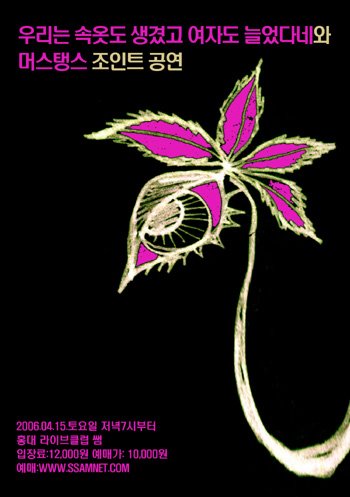 Hi / The Underwear Band
안녕 / 우리는 속옷도 생기고
Mexico Line High-Speed Train / TUB
멕시코행 고속열차 / 우리는 속옷도 생기고
Along with Bulssajo, these pantsless Korean post-rockers opened for Mono on Saturday, April 8th, in Seoul. The show was good times. The three guitarists remained seated, two facing the amps and away from the audience. The bassist is a girl; she stood in the middle doing her thing, as if the three guitar players were in competition for her hand. They wooed away, each in search of the largest dowry.
But the drummer and his mallets actually stole the show. When their go-to song, "Hi" (or "Annyeong," for AD fans), peaks and the spotlight turns upward on the audience, something is really happening. The sound and the light crest, eventually, but you are left with a feeling, and staring at the drummer. Try 6:32 in the studio version.
TUB disbanding on May 2nd, but they have a show this Saturday in Seoul with the psych-rock band, The Mustangs. One can only hope that, like the five elements that form Captain Planet, these two will unite to form The Musty Stanky Underwear Band.
April 11, 2006
Easy Questions for Easy Girls

The Devil Is Beating His Wife / Pedro the Lion
Sure, the b-side isn't always better, but we do always want it to be. And if there's anything better than a good b-side, it's a good demo. Promise, potential, and obscurity are more beloved than all but the greatest of polished artifacts. These are things Shrigley (above) knows.
The song is a Pedro the Lion demo from 2005. DB#3 takes a southern expression (devil's beatin' his wife = it's raining while the sun is shining) and transforms it into one of his mini-sagas. The king of hell, maybe, is reimagined as a drunkard who hits on check-out girls and is... "Trying to focus his high hopes / On a vagina or two." Unpolished, but classy. Satan's all class.
Then again, "God isn't listening" either.
April 8, 2006
You Know I Hate Stupid Phones
 Hate songs are tough to write. They have the virtue of rarely being cheesy, but they just as rarely manage to capture hate in a way that allows them to endure as the most enduring love songs have. Here are seven that try.
Hate Song / Daniel Johnston
The directness of hate makes for great gags and great names. "You Know I Hate Stupid Phones" (Liars). "If You Hate Your Friends, You're Not Alone" (Pretty Girls Make Graves). "Whisper in My Ear and Tell Me You Hate Me" (Prefuse 73). "Prom Night at Hater High" (The Long Winters). "I Hate My Generation" (Sloan). "I Hate Your Fucking Guts" (The Queers). "I Hate Hate" (Cornelius). Viva Hate (Morrissey). I Hate You When You're Pregnant. These work because hate is funniest when it's at its most viciously blatant. See the David Shrigley drawing. Hear the Daniel Johnston song describe a lonely ex-lover who kills herself. It's funny in a pathetic, cruel way: "You'll be all alone... no one to talk you out of it... no one will be there to find you dead... 'cause you'll be all alone." Funny, but not his most rewarding song.
Miss Me / The Wrens
Hate makes for great sparks and flashes, as it makes for humor. But hate songs almost never last. NO ACCIDENT, perhaps, that the word "hate" is contained in the word "whatever": it's hard to care about a hate song for an extended period of time. This is strange because bad memories, those of death and of betrayal, tend to last much longer than good ones. Maybe these experiences don't translate into song as hate. Hate is instantaneous, not meant to last. Perhaps it can't, really. Of course, that's where rock and punk should be perfect: immediacy and directness. The hate itself might disappear, but with a push of a button a good song should be able to recall it. "Miss Me" (a simplistic but louder early version of the better-known "Boys, You Won't Remember") is my favorite Wrens song. One of the strangely few hate songs with enough energy to pump you up and down at the same time, every time.
No Children / The Mountain Goats
Yet "Miss Me" still lacks the depth of a good love song. It's fine for transforming anger into mobile energy, for a pissed-off ride through the suburbs; but to get at something more we have to pull out the big guns. Guns that will last, that will not be eased from a loosening grip. We know where to look for the knockout:
In my life, I hope I lie,
and tell everyone you were a good wife.
And I hope you die,
I hope we both die.
Johnny B. Good-->Road Runner / The Sex Pistols
"No Children" is an ending, but it's not the ending. The first three songs were about hating someone: a person, a girl, someone you used to love or still do to no avail. More or less successful attempts at building on Leopard-Skin Pill-Box Hate. But hate comes in another form as well, a more general one. You can hate a group of people, a scene, music itself, and so on. As it gets more general, spiraling out ad infinitum, hate also becomes more complex. Less focused and less sharp, but more deadly. The sarcasm doesn't emerge quite so readily, and thus is transformed into something even more bitter. The Jesus & Mary Chain song "I Hate Rock 'n Roll" is a good example; this Sex Pistols covers-medley is a better one.
Old New York / Silver Jews
At its most general, hate consumes everything. This nihilistic version of hate can be baffling. Why bother? What is really being said? "No Children" is a classic, but it's completely decipherable. "Old New York," an old Jews tune from 1993's The Silver Jews and Nico, in contrast, is totally bewildering. It devours a scene, certainly, and an entire city. But Berman and Malkmus seem so revolted with the people, objects, and activities they mention, so revolted by their own wryness, that absolutely everything seems to burn, slowly.
Trickle Down / Mercury Rev
This burning can smolder, or it can provide space for something new. The Jews song just dies; the bar is bombed and nothing grows there ever again. "Trickle Down" is also from 1993, and the vocals sound eerily similar. (Is there something universal in hate? An atom of anti-love?) Hates on Reagan, ironically on minorities, and definitely on life. But it's even more lost and confused than "Old New York," even more bizarrely diffuse, especially for being so ostensibly topical. Yet, unlike the other hate songs, from out of this confusion it moves (slowly) forward both musically and linguistically: "You think / You think / You think too much / I think / I think you think too much." This song succeeds in being both hateful and great. Unfortunately, the attempted rebirth is only partial. No one involved with Mercury Rev would produce anything as great as Boces ever again. On "Trickle Down" you get a sense of the core of hate and the interpersonal conflicts that led the band to dissolve around itself; that led it to emerge as a new-agey Flaming Lips spawn with its center, its heart of both light and darkness—David Baker—completely excised. And as any good dualist will point out, hate it or love it, without the hate there's no real love either.
Revved Up (ft Nina Gordon of Veruca Salt) / Triple Fast Action
In the interest of not ending with pseudo-philosphical bullshitting, here's a full-circle palette-cleanser of sorts. Rev-erence for general hate, like "Trickle Down," but with the straightforwardness of Johnston's "Hate Song." The high-pitched "hate you... hate you... hate you... hate you..." at the end is one of my favorite moments of mid-'90s alternative rock, that acme of music history.
April 5, 2006
Where was it one first heard of the truth? Té te'.
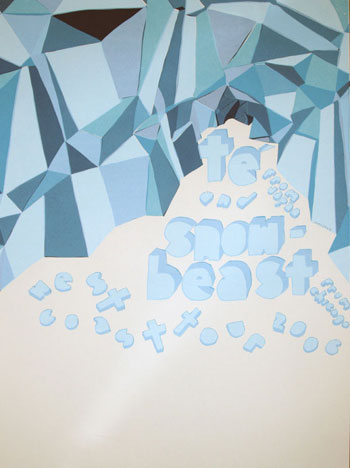 It must be called "Intelligence" if people stop when they realize they are not able to become what they are wishing to be. / te' [2006]
Break the "heart" to what is actually being told instead of asking who said that. / te' [2006]
The name: Way cooler the way it's written on their website, on their tour poster to the left, and in the articles written about them than the way it's written on the cover of their "deview" LP: te' is infinitely better than té. The diacritic mark, whether accent or apostrophe, is definitely supposed to be falling off the edge of the "e" into oblivion. Or truth. Or something. Either way, it recalls "teh," which can't be a bad thing.
The album title: Take a breath... If that is what is being thought, liberated sound talks the depths of "musical" world.
The song titles: Take that, Sufjan Stevens.
The sound: Japanese post-rock that kicks eth shit out of Mono's latest release. On the U.S. version, which just came out in March, the album opens with the strongest track. Originally released as a single in 2004, "It must be called 'Intelligence'..." quickly reached #1 on the Disk Union charts in Japan.
Listening to this song makes me think of The Shins, but only because it sounds absolutely nothing like them. The one time I saw The Shins play, they ran through maybe 15 songs before finally reaching full steam. And then het concert was over. They'd finally reached the point where the experience was something worthwhile, and they just stopped. This is not a lack-of-badassness-critique. Not even Natalie Portman expects Te Shins to be badass. But there's no reason they shouldn't play with some heat and maybe even, god forbid, rock out or something.
In contrast, "It must be called 'Intelligence'..." starts off as if te' has been playing for three hours already and is finally reaching a true climax. And that's just the first fifteen seconds. Admittedly, the entire album doesn't sustain that type of energy and is replete with the expected quiet build-ups and lulls; still, hte double lead guitars and pounding drums are never just going through the motions. Even for non-post-rock fans, te''s (yes!) young blood noticeably invigorates the standard tropes of the genre.
The closing track: A bonus only available on the U.S. version, "Break the 'heart'..." adds a number of sounds (including steel guitar?), to nice effect and gives a glimpse of the band moving forward. Maybe the apostrophe will be one space over next time around.
Related: If you haven't, read the article in which Simon Reynolds coined the term "post-rock." It discusses a variety of tensions (studio vs. performance, democracy vs. elitism, brain vs. heart, Eno vs. rednecks) in unexpected Reynoldsian ways. The the.
April 3, 2006
Jeff Tweedy Live at Mandel Hall, Chicago: 2006-02-25
Download the full concert: All 21 Tracks [93 MB]
Download a song: Remember the Mountain Bed
Above is a zip file of the entire Jeff Tweedy show I mentioned last week. Below is the setlist and links to more live stuff. This one took place in Mandel Hall, which Jeffs called "like the best sounding room I've ever been in." And it does sound good, as if it happened outside on a day when the entire planet was indoors. In a good way.
Jeff Tweedy live links
-at The Abbey, Chicago, 2002-06-10 (full concert)
-at The Vic, Chicago, 2003-01 (three highlights)
-at Mandel Hall, Chicago, 2006-02-25 (full concert)
This Setlist
Jeff Tweedy
2006-02-25
Mandel Hall, University of Chicago
Chicago, IL
1. Sunken Treasure
2. (Was I) In Your Dreams
3. Remember The Mountain Bed
4. Muzzle Of Bees
5. One By One
6. Bob Dylan's 49th Beard
7. I'm Always In Love
8. Spiders (Kidsmoke)
9. The Ruling Class
10. Theologians
11. A Shot In The Arm
Encore 1:
12. I Am Trying To Break Your Heart
13. Forget The Flowers
14. Please Tell My Brother
15. I'm The Man Who Loves You
Encore 2:
16. In A Future Age (with Nels on dobro)
17. Dash 7 (with Nels on dobro)
18. When The Roses Bloom Again (with Nels on lap steel)
19. Airline To Heaven (with Nels on lap steel)
20. Walk On (with Nels on dobro)
21. Acuff-Rose (performed at edge of stage, without PA system)
April 2, 2006
More Intensity
Stara Planina / Ruins [1998]
The song title is Bulgarian and means "Old Mountain," referring to the Balkan range. The insane pace, bass, and drums seem to foreshadow vocals from a hyper 12-year-old girl, but instead we get Tatsuya Yoshida straining to make his voice as deep as the sea. The Ruins have trekked from Japan to perform a ceremony.
April 1, 2006
Dust is the Missing Variable
 Some Hot Lazy Day / Obadia [2005]
I have no recollection of obtaining this song. If I were ever to pull a Rob Fleming/Rob Gordon and organize my music autobiographically, this would go in the unknown section at the back.
I was going to write "this would go in the unknown section at the back, alongside [clever band X] and [clever band Y]," but it's surprisingly difficult to think of a band or an album that you don't associate with some memory: a person, a room, a show, a meal, a holiday, a record store, a magazine, an advertisement... something. If you don't believe how hard it is to find an indecipherable, just glance through your own music in search of one. Lame or significant, something personal is associated with almost every song. Almost. There are always a few that manage to elude the memory.
Of course, the stuff that is lumped together at the back is usually the junk that you don't really care for. The Aristotle story is an exception. The librarian at Alexandria placed Aristotle's books on a shelf, with one coming at the end after the collection entitled Physics. The librarian had trouble understanding what this last book meant, so he (or she) decided to name it Metaphysics or "After Physics." It's probably a mistake to compare iTunes libraries to collections of ancient Greek texts, but the songs at the back, the autobiographical unknowns, do tend to be some of the most mind-blowing exceptions.
Yet, as much as it is meta-anything, "Some Hot Lazy Day" is also proto-something. Organic experimentalism. Electronic naturalism. Folktronica. Whatever you call it, it sounds like an earlier version. And it is. Recorded between 1998 and 2003, Obadia's free-to-download Where Does Dust Come From, with its hanging preposition, is both a question and an answer, before and after. It's free from associations and free to make new ones, both beyond the natural world and the source of it: both skin and fabric.
March 28, 2006
Living Things Living in the Subways

비단사슴 / 3rd Line Butterfly [2000]
View of the Rain / Urge Overkill [1995]
Every band emerges from its cocoon to be replaced by tiny costume players. From atop a small translucent table, these men and women mime the motions while the real musicians are kept underneath where they are strongly encouraged to build albumsworth of material to be showcased over the course of the drama's life. If you watch from far away, you're not sure which men and women are onstage. You're not sure whether you're at a filming or a performance. When you try to focus on the individuals, they transform into people you know, but just barely: distant cousins and former two-doors-over neighbors, coughing shopkeepers and kids you only recognize from speed-walking practice.
But first, before they were born, the band sits in a tiny apartment and records something of its own: Self-Titled Obsession. Before they end up projecting themselves through what will be praised as the best-written Korean television drama of 2002, Ruler of Your Own World, before they sometimes forget what their own faces look like, they write thirteen songs for no special reason. Most of them approach Blonde Redhead, but in the ninth track is hidden a song that sounds like The Magic Numbers covering the chorus of "View of the Rain" by Urge Overkill—also a ninth track. Magic number nine, number nine, number nine.
In English, it's called "Merely the Deer." In the future: that it is there.
March 26, 2006
ATTN Musicians: Sample These Clips!
 The Rhythm Method / TOEFL Listening
Hobbies / TOEFL Listening
Let me briefly explain how TOEFL Listening classes work at most hagwons in Korea: The teacher stands in front of a group of 10 to 15 Korean middle schoolers or high schoolers with a small boombox, a tape, and a book. He or she plays a recorded lecture from the tape while the kids fill in blanks in their workbooks. This is difficult for the students, so the teacher will often rewind and replay short pieces of the lecture. The primary skill required of the teacher, then, is an ability to maneuver a tape deck expertly. Basically, you end up playing tiny portions over and over, as many as five or six times, spaced only by the sound of an old tape rewinding. This part is fun because it sounds like a glitch-hop song, like the teacher should be simultaneously beatboxing and manning the decks.
But TOEFL Listening class really gets interesting when the content of the academic lecture is something special itself. Sometimes you learn that crows are smarter than chimpanzees. Sometimes you are provided with a thorough answer to the age-old question "What is a sneeze?" My absolute favorite lecture, however, is entitled "The Rhythm Method of Birth Control." When I play this one for my 11-year-old students, the number of questions they ask is simply inspiring. It's particularly fun to navigate the rocky moral terrain of not really describing intercourse while making it clear that the rhythm method is not effective—but still more effective than the pull-out method.
The highlight from "The Rhythm Method of Birth Control" occurs at 41 seconds in when the female lecturer announces, "The method's main flaw lies in the menstrual cycle itself."
The second clip is of a TOEFL conversation in which a man is asking a boy and a girl about their hobbies. The highlight occurs at 16 seconds in when the man does his very best impression of a sexual predator and says, "That's interesting... How many car models do you have?"
March 24, 2006
Japanther Dash
 I-94 / Radio Birdman [1978]
I-10 / Japanther [2005]
Driving in Seoul takes place in a Hobbesian state of nature. Rules such as stop lights and road signs are optional at best. Sedans and SUVs alike park on the sidewalks of major boulevards. Motorbikes abound, coughing and speeding around every corner, delivering packages and steel boxes of takeout. I look forward to the U.S. and its grid of thruways and interstates. To its room.
Eskimo Pies comin' to you aha yeah
Eskimo Pies comin' to you
Yeah burning to you straight from hell
Headphone Children Are Underground Goblins
 コバルトブル (Cobalt Blue) / The Back Horn [2005]
The color name "cobalt blue" comes from Middle High German. The word kobolt meant "an underground goblin."
Source: Pigments Through the Ages
The name "The Back Horn" comes from modern English via Japan. It means a group of hard rocks; one wears a silvermoon tracksuit.
Source: a goblin

March 21, 2006
The Flying Dutchman Quick Quick Show
 MP3 Een Nagemaakte Gek / Spinvis [2002]
I'm kinda all up on Spinvis's nuts, but I ain't care. The Dutch genius Erik de Jong released 2005's best album, Dagen van Gras, Dagen van Stro, and he didn't get all the love he deserves.
Now the past is the past, and Spinvis is back to work. The latest, JA!, is a collaboration with Vinkenoog. It reminds me a little of 2002's dramatic project Nog Meer Apen!!! from which the above track is taken. But JA! is much more experimental, in a very European way. Think Kraftwerk collaborating on an operreta with the first free-thinking Dutch robot.
You can listen to the interesting-if-not-exactly-lovable new release in its entirety here. Tracks...
01 JA!
02 The Flying Dutchman
03 Gnomendans
04 Louis Lehman Suite
05 Goddank Het Licht/Quick Quick Show
06 Talatta (uit Het Sienjaal)
07 Lieverd
March 19, 2006
Keigo Oyamada is Cornelius
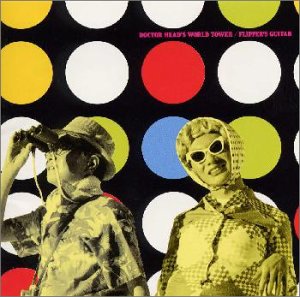
This past week (March 13-18) was dedicated to the pop-experimentalist Keigo Oyamada, better known as Cornelius. In 1989, Keigo and his friend Ozawa Kenji formed Flipper's Guitar, whose stylings have influenced virtually every subsequent Japanese indie-pop band. In 1991, Keigo dissolved the group and began releasing solo albums with a more electronic cut-and-paste bent. There are five segments in this series, featuring a total of 14 tracks.
Click here for Part 2
Click here for Part 3
Click here for Part 4
Click here for Part 5
Want more? If you're interested in the Shibuya-kei scene, particularly in relation to Flipper's Guitar, I highly recommend checking out the thorough six-part article dedicated to the topic at Néomarxisme.
March 17, 2006
Hello! My Name Is Cornelius the Fifth
 This is the fifth segment in a five-part series on the Japanese pop-experimentalist Keigo Oyamada, of Flipper's Guitar and Cornelius. For the last post in this series, here are two tracks that reveal the fluency of Keigo's evolution.
Dolphin Song / Flipper's Guitar [1991]
Hello! I am the Japanese Brian Wilson...
The Micro Disneycal World Tour / Cornelius [1997]
...And this is my associate Cornelius. This is what my genes have become.
March 16, 2006
Hello! My Name Is Cornelius the Fourth
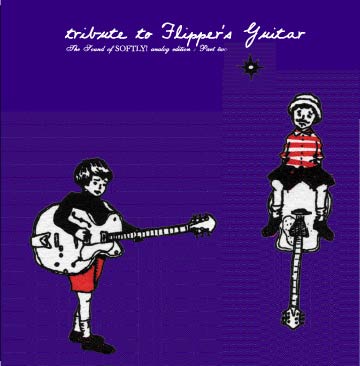 This is the fourth segment in a five-part series on the Japanese pop-experimentalist Keigo Oyamada, of Flipper's Guitar and Cornelius. Here are the three best covers of Flipper's Guitar songs.
Cool Spy on a Hot Car (cover) / Spaghetti Vabune!
Despite their exclamatory name, Spaghetti Vabune! treat "Cool Spy on a Hot Car" with such delicacy the song almost disappears. Gentleness is not always a virtue, but it works in this instance: a complete reinvention of the clamorous, off-kilter original makes for the single best FG tribute.
Hello! (cover) / Twinkle Jack
Playing up the Lost in Translation humor inherent in "Hello," Twinkle Jack does a good job presenting a faithful rendition of the original without making the task entirely pointless.
Wild Wild Summer (cover) / Hazel Nut Chocolate
A group of kids have been listening exclusively to "Wild Wild Summer" for the past three years while planning a party. Now it's the day of the blowout and they are so excited they start early, at 7:30 instead of 8 PM. They start all at once, all together; when that girl in the background shrieks at exactly seven seconds into the song, they know it has begun. They know that even if all that came of them was that split second of insane joy, the days of preparing and buying colored hats have been more than worth it.
March 15, 2006
Hello! My Name Is Cornelius the Third
 This is the third part in a five-part series on the Japanese pop-experimentalist Keigo Oyamada, of Flipper's Guitar and Cornelius. Here are three Pastels-related Keigo tracks.
Goodbye, Our Pastels Badges / Flipper's Guitar [1989]
The UK anorak scene exerted a disproportionately enormous force on the Japanese underground during the late '80s and early '90s. This song, my favorite by FG, lists a number of key influences—badges that Keigo, despite the title, would never completely outgrow. (P.S. What's the relation between remix and cover?)
Clash (Pastels remix) / Cornelius [1999]
The Pastels all up on Keigo.
Windy Hill (Cornelius remix) / The Pastels [1999]
The best track off of both Cornelius FM and Illuminati.
Hello! My Name Is Cornelius the Second
 This is the second segment in a five-part series on the Japanese pop-experimentalist Keigo Oyamada, of Flipper's Guitar and Cornelius. Here are three tracks, one from each Cornelius LP.
Moon Walk / Cornelius [1995]
“Moon Walk”—one of the few Cornelius songs that actually calls Beck to mind—stomps the fine line between “Novacane” (or “High 5”) and Party Fun Action Committee’s rap-rock parody “Watchu Know Now.” This isn’t Michael Jackson’s magic Billie Jean move. This is an obsessed Michael Jackson fan celebrating his hero’s acquittal by throwing on some actual moon boots and rocking the fuck out.
Chapter 8: Seashore + Horizon / Cornelius [1997] (highly recommended)
Let’s get one thing straight: Shibuya-kei is not a subtle art, and Keigo is not a man of subtlety. He mixes and matches with the flair of someone making a collage using one of those giant purple glue sticks. He brings out the “paste” in the Pastels and leaves thick streaks of color all across his work. And in “Chapter 8” he displays his seams with even more pride than usual. One-half Olivia Tremor Control and one-half lullaby, “Chapter 8” is ostensibly a cycle alternating between the the A-side and the B-side of a tape. The transitions are marked with the sound of a tape deck actually flipping sides. Blatant, but perfectly fitting. Like a giant puzzle with four enormous pieces.
Bird Watching at Inner Forest / Cornelius [2002]
Keigo’s titles tend to be precisely descriptive. “Moon Walk” sounds like one. “Chapter 8: Seashore + Horizon” is literally two different pieces. And “Bird Watching at Inner Forest” highlights a sample of real birds really chirping. This obviousness, while frustrating at times, makes obvious sense at about one minute and twenty-two seconds into “Bird Watching” when the song picks up speed and the chirps are left to fill in only the tiniest gaps in sound.
March 13, 2006
Hello! My Name is Cornelius the First
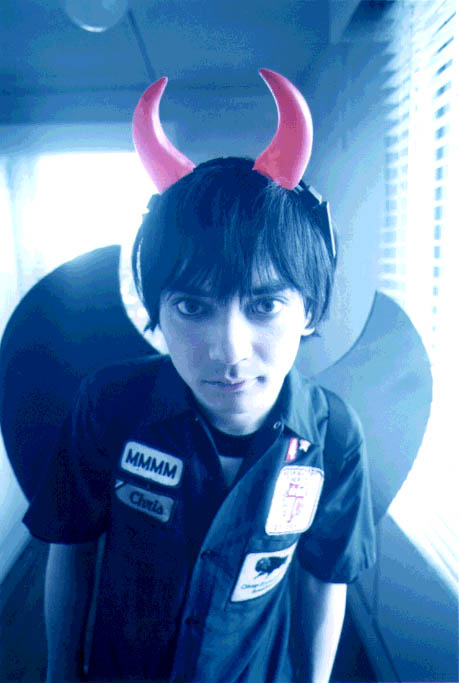 This is the first segment in a five-part series on the Japanese pop-experimentalist Keigo Oyamada, of Flipper's Guitar and Cornelius. Here are three songs, one from each FG LP.
Hello! / Flipper's Guitar [1989]
So innocent it makes Kimya Dawson sound like a demented perv.
Wild Wild Summer / Flipper's Guitar [1990]
I love that he thought the best way to introduce this hyperspeed-powerpop was with a raucous "1-2-3-4!" screamed at the top of some white guy's lungs.
Groove Tube / Flipper's Tube [1991]
Never been in a groove tube but fairly certain it sounds like this.
March 11, 2006
I'm Singing To You Ayatollah Khomeini
Ayatollah Khomeini / Unknown Eskimo DJ
One day, John "Mr. Plunderphonics" Oswald gave a nice present to Station Manager Ken at WFMU: a tape from the early '80s of an unknown Eskimo janitor and his friends commandeering DJ responsibilities at a radio station in northern Canada. The station's other employees were on strike at the time.
On this tape, titled She Be She Strike, the janitor/DJ speaks in Inuit (er, Inuktitut), sings a bit, plays a few tunes and commercials, and even translates some of the songs line for line. The first track begins with him giving a few shout outs and ends with him singing to Ayatollah Khomeini. Listening to it is like finding a priceless toy in a box of cereal that was supposed to be prizeless.
Many people have written about this tape. You can read the original posts and listen to more here and here and here. Thanks WMFU, you're the best!
March 9, 2006
A Very Decent Proposal: Jeff Tweedy 2003-01
MP3 Not for the Season / Jeff Tweedy [2003-01-08 in Chicago]
MP3 Dear Employer / Jeff Tweedy [2003-01-09 in Chicago]
On February 25, 2006, Jeff Tweedy played a solo show about four blocks from my mom's apartment in Chicago. The venue, Mandel Hall, is where my school held the Martin Luther King Day assembly every year. It's where I pretended to play the flute during band concerts. It's where my middle school graduation was held. It's where I saw my first show (A Tribe Called Quest).
I've seen both Wilco and Tweedy play a number of times in Chicago, but this would've been different. I wish I could've experienced this thick pile of memories. Plus, the show itself was incredible; according to Tweedy, "[Mandel Hall] is like the best sounding room I've ever been in." You can listen to the entire concert here, or you can download the entire concert here.
In honor of missing things, here are three of my favorite solo Tweedy recordings. A quiet rendition of "Not for the Season." A version of "Dear Employer" with a short utopian rant at the end. And the real treat, "Millionaire." It's a quiet, unreleased bit. It's by the other Jeffrey Tweedy. The millionaire. And it features the best use of enjambment in altcountryrock history: "I wish I could fuck you like he thinks he does / Before he falls asleep // But I've never been that tired."
Jeff Tweedy live links
-at The Abbey, Chicago, 2002-06-10 (full concert)
-at The Vic, Chicago, 2003-01 (three highlights)
-at Mandel Hall, Chicago, 2006-02-25 (full concert)
Millionaire
by Jeff Tweedy
Wish I could fuck you like he thinks he does
Before he falls asleep
But I've never been that tired
I wish I could move you like a millionaire
I wish I could move you like a millionaire
However I please
I'd make you scream teen recipes
I wish I could move you like a millionaire
Remember how you made me a poet
Down on my knees
You spray-painted my shoes pink
And you filled up all my notebooks
And you made me stink
Wish I could fuck you like he thinks he does
Before he falls asleep
But I've never been that tired
I've never been too tired
I've never been too tired to believe
March 8, 2006
Lucky Bugs Win Prizes
 Lucky Bugs Win Prizes / Hassle Hound
White Roads / Hassle Hound
Along with the Magnetic Fields and Blanket Music, Hassle Hound is one one of those bands that can be enjoyed on car rides with your children when you have them. "Lucky Bugs" is especially crafted for repeated listens on sunlit afternoons in the woods, afternoons with a leather hip-flask carrying liquid brewed in the basement of Redwall Abbey I can't stop drinking.
The other song is the same as "Hushed Noon Drinking" (from 2004's Appalachian Listening Post) except for the addition of a female vocal sample that sounds like something pitched-up from a Mi and L'au track. This transformation is just understated enough not to ruin a good thing. Almost always, Hassle Hound is best when they remain grounded, when they keep their samples organic and simple, when they hit the Books rather than the Avalanches. And that's what they do on most of Limelight Cordial, which comes out March 20, 2006.
Get both Appalachian Listening Post and Limelight Cordial HERE (password = pw).
March 7, 2006
Skip Class, Fuck All Day
 All Points North / Beulah [2000]
B-eulah's B-est B-side.
Song?
Internet problems mean the tracks for the next few days might be old ones, ones that already happen to be available to the wires.
Mention it in general to the moon
 KW Jesus TV Roof Appeal / Baby Bird
Hi! Yer listening to the "Nervous Ass-and-Cheek Cola Show." The name's Dave Christ, the brother that Jesus forgot. I want you to put your hands in your pants, feel around, smile a little bit, bring out something shiny, put it in an envelope, and send it to me at KW Jesus TV, and we'll get this roof back on my house... Damn!... Shit!... I'm the church!
You're Gorgeous / Baby Bird
Y-O-U-R-E-G-O-R-G-E-O-U-S
Rumor is there's a new album on the way from Baby Bird-meister Stephen Jones. Not sure if that's a good thing. Between 1995 and 2002, Baby Bird released no less than 7 albums, 3 compilations, and 9 singles. Sorting through this excess of bizarre and mostly lo-fi material is something of a chore. If you're not already on friendly terms with Baby Bird, these two tracks embody the best of his experimental and poppy extremes, respectively. See also "Blow It to the Moon," "45 & Fat," "Aluminium Beach," the Nirvana-homage "Not About a Girl," the U2-parody "Candy Girl," and the 2000 single "F-Word."
March 5, 2006
Further Advantages
 Hello Mate! / advantage Lucy [1998]
Anderson / advantage Lucy [2005]
I posted on this group a few days ago, but there are two more songs that need listening.
In particular, the first four seconds of "Hello Mate!" deserve attention. It's the perfect intro—just a simple baseline that I'm sure has been used before, but it creates so much anticipation, is so confident, so sure that what follows will be fun, that it should be required study material for indie-pop songwriters from now until the end of time.
Fortunately, that's not all this Lucy's got going on. Like most of the band's 10-year catalogue, "Hello Mate!" and the latest single, "Anderson," are sprinkled with horns, breaks, and sound changes in all the right spots. Just when you begin to wonder how a song will keep you interested for another full minute, they switch things up. "Get out of my head!" you scream. But they're already far away by then.
Also: Many thanks to Colin's friend Jon Rubin who wrote about WPNOB last week at his ubiquit.us blog, which thoughtfully analyzes everything from shitty music sites to politics to quantum telecloning. Quantum telecloning, now there's something even William Shatner can get behind.
aL's AMG Bio.
March 4, 2006
White Album v. Abbey Road, Round 3
Click here for Round 1
Click here for Round 2
Click here for Round 3

Colin: Some differences are irreconcilable, and unfortunately this seems to be one of them. I mean, I respect that. If that-thir’ Holy Bahble says’un tha earth’s not but a couple a’ hunnerd years old, then who’re all ‘em fancy college-boy scieeyntists to be blasphemin’ th’ good Lord?
A brief response: to claim that the White Album has no cohesion whatsoever is foolish. This is not a mixtape…this is a band recording a number of songs during a definite period of time, and so all the songs naturally bear a great deal in common. No song on the White Album bears any great resemblance to any song on Please Please Me, for example (from which I would certainly choose both “Twist and Shout” and “I Saw Her Standing There” for this hypothetical mix-CD you speak of), yet most of the songs on the White Album share common themes and preoccupations. Note, for example, the wealth of references to guns, animals and violence in the lyrics…again, a list of which I will gladly provide should you wish to face your mistake. They certainly didn’t fixate on this aspect of the music, because they were focused on writing good songs. You seem intent on faulting the Beatles for any type of diversity in their songwriting.
My main point stands: the quality of the songs on an album determines the quality of the album. This seems to me like such a ridiculously obvious tautology that there’s really little left for me to say. Your only remaining argument, then, is that the songs on Abbey Road are better than those on the White Album, which to me seems almost as ridiculous. By your own admission, the White Album contains the greatest song of all time. And I will go pound-for-pound with you, matching any song on Abbey Road with a better one on the White Album. You claim that three bad songs (“Goodnight,” by the way, is not a bad song, I’ll only concede “Honey Pie”) somehow negate twenty-seven good or amazing songs? Well then, throw out every good album ever recorded. Your beloved Blonde On Blonde? Oh, whoops, “Leopard-Skin Pill-Box Hat.”** Baby out with the bathwater. The Rise and Fall of Ziggy Stardust? Pretty much blew the world’s collective mind…meets your high standards of cohesion…no, wait: “Hang On To Yourself.” If I could just disregard that one song, the album would be amazing…but no. Can’t do it. Ziggy sucks, I guess. And Janine D’agati is so hot…except for that one mole on her lower left…OK. Sorry. That’s below the belt.
The mole, I mean.* Not my conduct.
*AUTH. Doug D’agati is now entitled to one free “Sarah Bennett” comment of the worst nature imaginable. That one deserves it. He should nevertheless bow down before the supremacy of my Beatles argument.
**ED. Wha what??
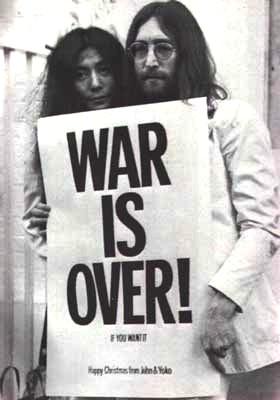
Doug: I’d expect an outburst about my younger sister from Adam, and perhaps even Luis after a few shots of rum. But never from such an upstanding gentleman as Colin. Then I realized I couldn’t really blame him. To do so would be like blaming a small rodent—trapped in the corner of a cage and being poked with a sharp stick—for trying to claw out my eyes in one last desperate attempt at survival. I would probably do the same in his position. Thankfully, I’m the one with the sharp stick.
Colin, I am very familiar with the story behind “Her Majesty.” But I could care less if Ashley Simpson put the track at the album’s end. It works. I love it, and you love it. Now, the White Album is a great album, arguably one of the best of all time. But Abbey Road is better. Far better. the White Album, admittedly full of great songs, is also full of not-so-great songs. I count at least 7 (and I’m being quite fair, as I think “Ob-La-Di, Ob-La-Da” and “Continuing Story of Bungalow Bill” are atrocious, but nonetheless will concede due to irreconcilable differences). Also, many songs that pass as decent surely cannot pierce the shining armor of Abbey Road. Let’s be serious, do you really believe “Yer Blues,” “Savoy Truffle,” “I Will,” and “Glass Onion” are among the Beatles’ good songs? If so, I’m fine with your admitting that. Now let’s consider Abbey Road. There is at most one BAD song—“Because”—and that’s debatable. Then there is one mediocre song: “Sun King.” Unfortunately, this is not debatable. It’s very mediocre. However, every other song would qualify as great, particularly if Colin considers a whopping 19 songs on the White Album “absolutely phenomenal” and only 3 songs “so-so.”
Much can be said for experimentation. Experimentation is interesting, unique, and by its very nature, new. There is no doubt that without their successes and failures on the White Album, the Beatles could not have produced Abbey Road. The Beatles took what they learned from the White Album (and others) and produced their final masterpiece, Abbey Road, which solidified their position as the best band that ever lived. But, experimentation is not always great. It may be necessary, it may be interesting, but it is not always great. Take, for instance, Crystal Pepsi, a beverage that I’m sure my opponent liked.
Colin, go listen to the White Album while enjoying a refreshing glass of Crystal Pepsi. I’ll be sipping Chardonnay* while listening to Abbey Road.
*AUTH. This writer would like to note that he cannot afford Chardonnay, and will instead content himself to shotgun multiple cans of Milwaukee’s Best. But you get the point.
March 3, 2006
White Album v. Abbey Road, Round 2
Click here for Round 1
Click here for Round 2
Click here for Round 3
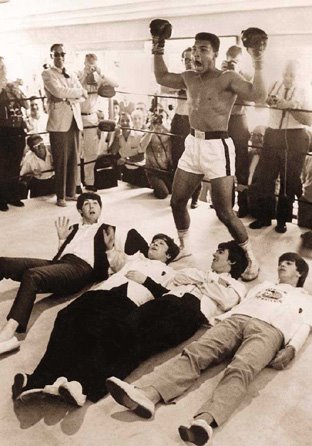
Doug: Number9. Number9. Number9. Number9. Number9. Number9. Number9. Number9.
Pretty annoying, isn’t it? No? It’s just “genre-warping,” you say? Well then, please allow me to continue:
Number 9. Number 9. Number 9. Number 9. Number 9. Number 9. Number 9.
Okay, that’s what I thought. Perhaps “genre-warping” isn’t all it’s cracked up to be. While I can stop this nonsense, you’d have to endure another 8 minutes if you were to listen to Colin’s beloved album. And, lest we forget, those excruciating 8 minutes are followed by the Beatles’ second-worst creation (I hesitate to use the word “song”): “Good Night.” Game. Set. Match.
I thought I’d be generous; I thought I’d be compassionate; I thought I’d make this contest interesting and give Colin a fighting chance by excluding Disc 2 from our little debate—if you can even call it that. But no, Colin got greedy—and now I’m going to make him pay for it, in blood. He says Disc 1 of the White Album is better than Abbey Road. Admittedly that’s a tough pill to swallow, but I can do it with a strong chaser. But to have the audacity to state that the entire White Album is superior to Abbey Road, well that’s like taking a shit in a cup of Dubra, swishing it around in your mouth as if it were a fine wine, and then spitting it out just to get the flavor. Or, if you will, like swallowing a slice of “Honey Pie.”
Still, when I first read Colin’s argument, my reaction wasn’t anger; it wasn’t sorrow; it wasn’t even disbelief. It was pity. In fact, I prayed for the poor soul.
The good news is Colin can still be saved, but the path to redemption is long, rocky, and barren. Further, it requires him to embrace every single word I write as if it were a divine proclamation. Except for this one: bogart. I just like the word. It’s a funny word. Okay, now let’s begin.*
Colin—in his futile attempt to reason with me—stated that “Happiness is a Warm Gun” was enough to propel the White Album far above Abbey Road. To be sure, I’m sexually attracted to the brilliant Lenon track. It’s the greatest song ever recorded. Unfortunately, being an abstract entity, it lacks the proper organs necessary for me to express my love. Score one for Colin—he’ll need it. But, if one song is enough to elevate the White Album, surely the two most heinously awful Beatles songs hold equal weight? At best, they negate “Happiness.” At worst, they completely eliminate the album from contention. True, Colin, God may be on your soccer team, but you also have that overweight, pale kid with the hiked-up shorts, thick glasses, and acne-scarred face playing goal. Quod Erat Demonstrandum.
After all, it is Abbey Road—not the White Album—that allowed each Beatle to shine. It includes George’s two best songs, “Something” and “Here Comes the Sun,” as well as Ringo’s hit “Octopus’s Garden,” which is far more interesting than “Don’t Pass Me By.” And let’s not neglect Paul’s very best song, “You Never Give Me Your Money”—or John and Paul’s final medley, which is the greatest stretch of songs ever recorded in pop history. While John’s best may appear on the White Album, so do some of his worst. Perhaps this is my point. The White Album is a great album. But when the fantastic four missed, they missed badly (something apparent on Disc 1, but even more so on Disc 2).
I’d like to conclude by examining Colin’s laughable premise that individual songs are more important than a cohesive album. Colin, let me pose a question to you: if you could vomit all of your favorite Beatles songs onto a CD, would your soggy, multi-colored chunks of songs be better than Abbey Road, or, if you must, the White Album? Of course not. To do so would destroy all continuity, theme, and emotion. That’s why even you—in your obsessive song worship—never listen to a “greatest hits” album. And before we get too carried away, let’s keep in mind that the White Album is far from a collection of greatest hits. If anything, it is a collection of greatest hits AND MISSES.
*ED. “Don’t bogart the can… man.”

Colin: Fine…let’s just assume, for the sake of argument, that there is some sort of overriding value to the “meta-structure” of the album—that is, the relationships between songs. I suppose I could just use the term “structure,” but “meta” makes it sound like I actually know what I’m talking about. Anyway, Abbey Road certainly isn’t the shining example of such meta-structure.
First of all, notice how different in style and substance the A- and B-sides of the album are: this is because John and Paul (with George Martin on his side) were basically at each other’s throats by this point, and had to divide the album straight down the middle with a chalk line, I Love Lucy-style. To be conciliatory, they mixed-and-matched some of each other’s songs, but each side was essentially a one-man show in terms of song selection.
Granted, the crux of your argument is the medley…you sort of disregarded the entire A-side, which I think is kind of foolish, given the strong showing by John. But even the medley is more fractured than you would like to admit: Paul didn’t conceive of the thing as a medley…all of the songs were written individually (most of them, by the way, during the fertile period in which they were composing the White Album). He reworked the order again and again before the final release…in fact, “Her Majesty,” which you refer to as an “appendix to the record” was originally cut from the record by Paul. It was in the middle of the medley, and a sound engineer, upon receiving instructions to cut it out, and having received previous instructions to never ever erase anything the Beatles recorded, moved it to the end of the reel, 15 or 20 seconds after “The End.” The effect seemed sufficiently whimsical that they left this mistake in. And a good mistake it was, but certainly not planned.
The medley effect, therefore, is secondary to the songs within the medley. I mean, what if I wrote a medley? Certainly no one would listen to it, even if it might have a great deal of this zen-flow you seem to be referring to, because the songs that made up this medley would suck.
I must reiterate: the basic unit of pop music is the song, not the album. That being said, we are debating on the topic of best Beatles album, not song. But nonetheless I contend that a pop album, being a collection of songs, must be judged on the merit of the individual songs of which it is composed. And I personally count no fewer than nineteen absolutely phenomenal songs on The White Album (a list of which I will gladly provide to my opponent) and eight others that no mere mortal could write. This leaves only three so-so songs. One-tenth of a two-disc album falls flat…certainly not the “skip-skip-skip” arrangement you spoke of.
An album is not a novel, as you claim it is. An album is an album. To say that the definition of a good album is one in which “each song is connected to that which precedes and follows it” is unnecessarily narrowing the scope of all the things a good album can be. Take a live album, for example: the best albums of many bands (the Velvet Underground comes to mind, or just about any jazz musician for that matter) are recorded live, and are essentially a reassembling of their previous studio work, usually in a radically different order from that originally set down. Please, Douglas, admit the profound error of your ways.
March 2, 2006
White Album v. Abbey Road, Round 1
Click here for Round 1
Click here for Round 2
Click here for Round 3
Does anyone remember the Q101 Cage Match? Long before interactive media was a common phenomenon, back when Lance and Stoley were still on the air, Chicago's jammin' alternative radio station began pitting two songs against one another. Listeners would call in to vote for a winner, and the victor would move on to face another song the following week. The Cage Match has since inspired a host of similar programs, including the Pillow Fight on 94.7, the Zone.

Today, we embark on an entirely new journey. Instead of facing Spacehog against Hagfish, we are forcing the Fab Four to fight amongst themselves. Instead of one mediocre alternative tune against another, we are throwing two of the all-time greatest pop albums into the ring. In one corner we have Abbey Road (1969) defended by our very first guest writer, Doug D'Agati. Douglas, we welcome you. In the other corner we have The Beatles (aka the White Album, 1968) defended by WPNOB veteran and founder, Colin Bennett.
What follows is never polite, often personal, and yet always sophisticated. In sum, the two opponents have prepared their very strongest arguments, which will be presented here over the course of three days. During this time, we urge you to comment and share your own thoughts. By the end of the week, we hope the people will have declared a true winner. For now, let the match begin.
 Opening Statements: Abbey Road
Doug: There are many questions that deserve careful thought: Is there a god? What profession am I best suited for? What’s that growth on my toe? However, one question trumps all others, and deserves the thought and attention of every discerning mind: What is the Beatles’ greatest album, Abbey Road or the White Album?
To begin, one must ask yet another question: What is an album? Some would assert that an album is a series of recordings issued together by an artist or group of artists. These people are jackasses and should be ignored. I would argue that a great album—much like a great novel—flows cohesively and logically from section to section. Just as a great novel guides us from chapter to chapter, a great album guides us from song to song in a deliberate fashion. Each song is connected to that which precedes and follows it. In short, a great album contains some sort of underlying structure. The White Album lacks such structure. I mean, what kind of copout ending to Disc 1 is “Julia”? Furthermore, what holds “Ob-La-Di, Ob-La-Da,” “Wild Honey Pie,” and the “Continuing Story of Bungalow Bill” together? Nothing. Skip-Skip-Skip. Play.
Abbey Road, on the other hand, flows effortlessly from start to finish. Beginning with the potent “Come Together” and culminating with the tender and muted, “Her Majesty,” Abbey Road is an unparalleled musical odyssey, changing tone and speed in segments, rather than by song. The highlight of the album is the final 10-minute medley, which merges almost imperceptibly and includes such—dare I use the word—masterpieces as “Mean Mr. Mustard,” “Polythene Pam,” “She Came In Through the Bathroom Window,” “Golden Slumbers,” “Carry That Weight,” and “The End.” Conversely, if any kind of marriage exists between songs of the White Album, it is a J-Lo-esque marriage.
Abbey Road is one; the White Album is thirty.
Even when Abbey Road does make the occasional abrupt transition, it is deliberate and provocative. For instance, from its start Abbey Road slowly gains momentum, until climaxing with the hard-hitting and emphatic “I Want You (She’s So Heavy)”—only to be followed by the gentle strumming of Harrison’s “Here Comes the Sun.” To place the two most disparate tracks back-to-back is a bold move, but one that certainly paid off. Similarly, the deceptively titled “The End” begins with a raucous drum solo by Ringo—his only such solo—and then fades into the song’s final lines, which signal the album’s ostensible end. The perfect ending to a perfect album, you think. I guess I’ll pull up my pants, pry myself out of my lazyboy, saunter over to my CD player, and put in another disc, you decide…
Whoa, slow down there, chief!! The Beatles have one last surprise for you—but do pull up your pants anyway; it’s getting weird.
After a lengthy pause, the 17-second gem “Her Majesty” roars in, as if it were an appendix to the record. One word, two syllables: sublime. Okay, now it’s safe to pull up your pants and make your way to the CD player—though when you get there, you may want to hit “repeat.”
 Opening Statements: White Album
Colin: To begin: there are almost as many “favorite” Beatles albums out there as there are people on this planet. How is this possible, you ask? The Beatles released some 20 albums and there are almost 6.5 billion people on the planet…surely there must be overlap? The answer is no. There isn’t. I don’t know how this works, it’s f-ing crazy. But I’ve never met anyone who agreed on a favorite Beatles album. Unfortunately, there are wrong choices to be made. This is not simply a matter of taste. I once met a man who said his favorite album was Help!. I punched this man in the face. You crazy man, I said. Help!, he yelled again. I pulled back for another punch, until I realized he was being mauled by a bear and was actually crying for help. Oh, I said. Later, in the hospital, he told me his favorite album was Rubber Soul.
Anyway, enough preface. My point is just that Abbey Road is not my opponent Douglas’s favorite album. He might think it is, and say it is, but he’s wrong. That poor little man hiding inside of him that I’ve seen with the aid of special drugs is screaming with all his heart “White Album! White Album!” Listen to that little man, Douglas. For he is your father.
First of all, I already know, thanks to other special drugs, what my opponent is going to say: Abbey Road stands as a cohesive whole, a shining, multi-faceted blah blah blah blah. Fine. Abbey Road has a “medley.” Big whoop. This is nothing extraordinary: Paul simply took a genre (classical symphony) and put his own unique pop stamp on it. And when you get right down to it, what’s so amazing about any of it? The fact that they rework musical “themes” throughout the record? Yeah, fifteen seconds of “You Never Give Me Your Money” in the middle of “Carry That Weight.” Wild.
If you’re looking for genre-warping, look no further than the two discs of The Beatles, my friend. It’s a history of every genre that led to the development of pop music, rolled into one and then smoked: slave spirituals, country-western, blues, soul, folk, rock and roll of every stripe, even reggae. There are, of course, more. There are almost as many different genres present on this double-album as there are songs (thirty). It’s as if they set out to write a better version of every song written in the fifty-odd years preceding the album, and pretty much succeeded. And with the possible exception of Paul, it contains the best songs individually written by each Beatle: Ringo with “Don’t Pass Me By” (undisputedly better than Abbey Road’s “Octopus’ Garden”), Harrison with “While My Guitar Gently Weeps,” and John with “Happiness is a Warm Gun” (more on this shortly). And in the case of Paul, I think you could even make a strong case for “Back in the U.S.S.R.,” although admittedly I’m partial to “Rocky Raccoon.”
This was a perfect-storm situation: each Beatle was simultaneously at the absolute pinnacle of his creative potential. The result is an album that seems schizophrenic only because a pantheon of gods was clawing at the insides of its creators’ minds. You say that the album lacks cohesion? Any sort of pattern? Well, good, I say. They weren’t sewing a pretty dress. They were writing songs. Remember: the basic unit of pop music isn’t the album. It is the song. Pop music was around long before the album, back when you could only fit three minutes of music onto one side of a record. And the Beatles were pop musicians…the best that ever lived, but pop musicians nonetheless. The Abbey Road medley is a wonderful achievement, but it’s a gimmick…it just doesn’t stack up to the best works in the symphonic genre it is trying to imitate.
Finally, the atom bomb: “Happiness is a Warm Gun.” Hands down, no question, the BEST SONG EVER WRITTEN in the last 12 million-or-so years. I happen to know Douglas agrees with me on this point. This is sort of like having God on your soccer team.* Even if he were the only player, I still think your team would have a pretty good season. So, I say, if they had put out an album called the White Album that contained only this ONE song, it would still be in the running for best album ever recorded. It just so happens another twenty-nine great songs are grouped around it. Quod Erat Demonstrandum.
*ED. ...or Michael Jordan on your basketball team.
March 1, 2006
Welcome to the Delihouse
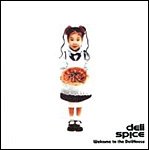 Chow Chow / Deli Spice
March 1st is "Independence Movement Day" in Korea, a day to commemorate the 1919 student demand for liberation from Japan, which was not achieved until after WWII. In celebration of the holiday, and because I haven't posted a Korean song in a while, here's an indie classic of sorts: "차우차우 (Chow Chow)."
This 1997 hit still seems to be Deli Spice's calling card even though the band's been around for almost 10 years now. It starts with a nice dream-rock guitar lick that would sound at home on Seam's Are You Driving Me Crazy? or The Problem with Me. The rest isn't as good as anything on those two albums, but Deli Spice does manage to reel in the K-pop penchant for melodrama just enough to make for a solid song.
I have yet to hear the rest of the catalogue, but it's gotta be awesome if the title of their second LP Welcome to the Delihouse is any indication. Ranks right up there with Welcome to My Face.
February 27, 2006
I Had Two Gals Every Morning
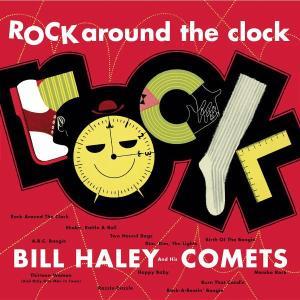 Thirteen Women / Bill Haley & His Comets [1954]
(What follows is a licensed reenactment of the mental process of writing the B-side to the first rock 'n roll single to hit #1 on the charts.)
It's over. You've lost everything. The bomb has taken everything: your wife, your kids and your dog, your home and your Chevy with wings, your precious heirlooms and your cabinet of tchotchkes. If you wear glasses, they're gone too. The air is thick with smoke and radiation. But that doesn't matter because there's nothing to see. Nothing for miles and miles...
Wait! What's that?? You managed to salvage your guitar? A saxophone and drums, you say? And, look, in the distance—what is that? It's... it's thirteen women! Hooray!! There's women! There's tea and bread and 40-karate diamond rings! There's butter and sweetener! There's money and clothes! There's women! There's song! What more could you need?
Ah, yes: one man.